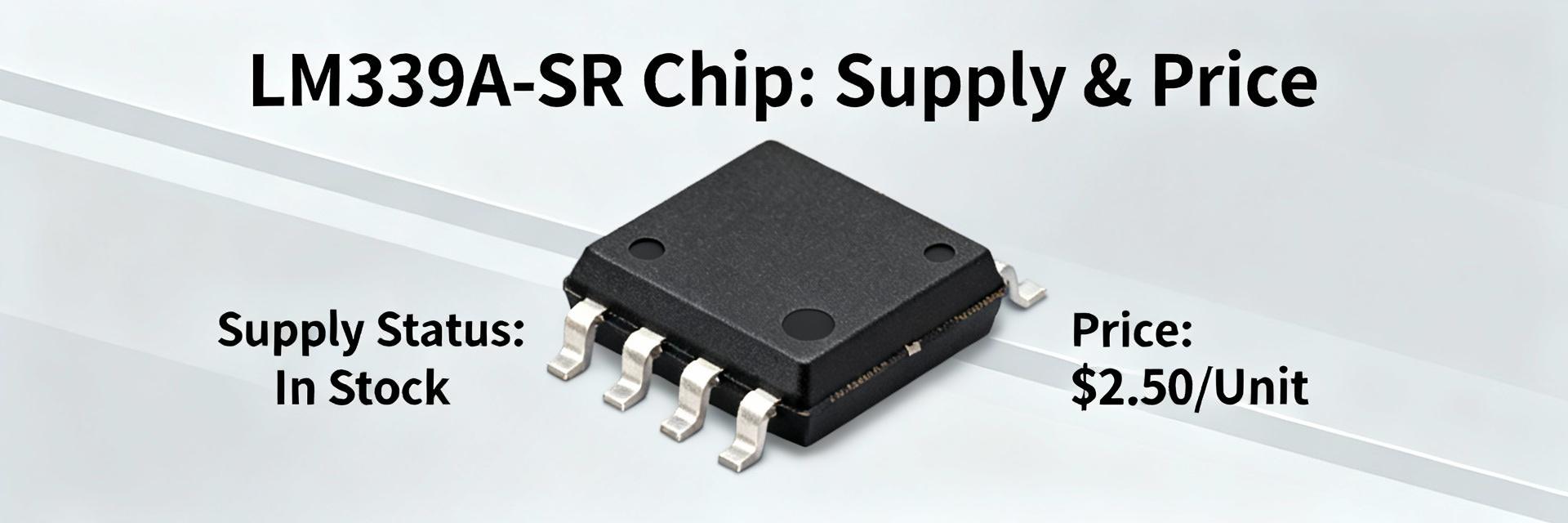
Distributor listings and spot quotes for LM339A-SR currently show unit prices ranging roughly from $0.06 to $1.15 depending on vendor, lot size and part source — a spread that signals sourcing variability buyers must manage. This brief, data-driven note summarizes the essential specs buyers should validate early, outlines the current supply and lead-time landscape, and delivers a practical two-track sourcing strategy (immediate tactical buys + longer-term qualification). The goal is to enable engineering and procurement teams to verify electrical specs, assess availability signals, and execute sample orders that limit production risk while controlling price exposure.
All technical parameters referenced here come from manufacturer datasheet excerpts and common distributor stock reports; procurement teams should confirm lot trace and certificate-of-conformance on receipt. The document emphasizes actionable checks (part marking, lot date, COA) and a short RFQ template to accelerate safe purchases for production builds.
1 — Background & Key Specs of LM339A-SR
Electrical specs snapshot
Point: The LM339A-SR is a quad comparator with open-collector outputs suited for single-supply or split-supply systems. Evidence: Typical datasheet entries list input common-mode range, output type, supply voltage range, input bias current, offset voltage, propagation delay, and operating temperature. Explanation: Validate typical vs. maximum values early; designs that push input range or speed should budget margin for offset and propagation delay.
| Parameter | Typical / Max / Units |
|---|---|
| Supply voltage (Vcc) | +2 V to +36 V / — / V |
| Input common‑mode range | Ground −0.1 V to Vcc −1.5 V / — / V |
| Output type | Open-collector / — / N/A |
| Input bias current | Typically few nA / ≤250 nA / A |
| Input offset voltage | Typically 2–5 mV / ≤5–10 mV / mV |
| Propagation delay | ~200–400 ns (depends on input step & Vcc) / — / ns |
| Operating temperature | -40 to +85 °C (commercial) / — / °C |
Package, pinout & variant notes
Point: The part is commonly available in 14-pin SOIC/SOP SMT and through‑hole equivalents; markings vary by maker. Evidence: Branded variants include the original manufacturer device and several third‑party-branded LM339A-SR releases. Explanation: Check package code and pin numbering against the official datasheet; verify RoHS marking and whether the shipped part is SMT or a through‑hole equivalent when placing sample orders.
2 — Current Supply Landscape & Lead Times for LM339A-SR
Authorized distributors vs COTS/marketplace listings
Point: Stock flags (in-stock, lead time, MOQ) on marketplace listings can be misleading. Evidence: Listings may show immediate stock for surplus lots while authorized manufacturer channels show constrained available quantities with standard lead times. Explanation: For critical designs, prioritize authorized/approved sources and require COA and lot trace. For low-risk prototype builds, COTS inventory is acceptable after visual and electrical spot checks.
- Mini-checklist when evaluating a listing: correct part-number and marking, lot date code, COA availability, package confirmation.
End-of-life, manufacturer status & alternate sources
Point: Lifecycle notes affect long-term availability and pricing. Evidence: Manufacturer product pages and lifecycle bulletins indicate active, NRND, or EOL status; those flags change stock behavior. Explanation: Track KPIs such as aggregated available qty across top sellers, average quoted lead time, and age of the last production batch to decide when to qualify alternates or increase safety stock.
3 — Price Analysis & Trends (spot vs. volume)
Price by vendor & quantity breakdown
Point: Unit price varies widely by order quantity and seller grading. Evidence: Representative spot checks cover common bands (1, 10, 100, 1k) showing steep discounts at volume and premium pricing for guaranteed-authorized lots. Explanation: Collect quotes across these bands and compare unit and total cost, accounting for packing, test grading, and any retest fees.
| Vendor (sample) | Qty band | Unit price | Stock | Lead time |
|---|---|---|---|---|
| Vendor A | 1 | $0.95 | 10 | 5 days |
| Vendor B | 100 | $0.12 | 500 | 14 days |
| Vendor C (surplus) | 1k | $0.06 | 2k | 30+ days |
Drivers of price movement & negotiation levers
Point: Price drivers include OEM production, third‑party clones, order quantity, and certification needs. Evidence: Authorized stock commands a premium; surplus or re‑graded parts are cheaper. Explanation: Negotiate using RFQs to multiple sellers, request small sample lots first, consider blanket POs to lock price, and accept higher price for traceable, authorized stock when production risk is high.
4 — Integration & Test Guidance for Designers
Practical PCB & circuit integration tips
Point: Proper PCB layout and pull-up strategies prevent common comparator issues. Evidence: Open-collector outputs require pull-up resistors; input protection avoids latch-up when inputs exceed rails. Explanation: Use local bypass caps on Vcc (0.1 μF + 10 μF), choose 4.7 kΩ–10 kΩ pull-ups for typical TTL/CMOS interfaces, add series resistors on inputs to limit current if inputs can exceed rail, and maintain short traces on input pins to reduce coupling and oscillation.
Test, qualification & failure-mode checklist
Point: A concise lab qualification reduces field failures. Evidence: Bench tests should exercise offset, hysteresis, propagation delay at expected Vcc and temperatures. Explanation: Run DC offset and hysteresis checks, measure propagation delay with expected input swing and pull-up load, perform thermal cycling and simple burn-in, and apply ESD precautions—especially for lots sourced from non-authorized sellers.
5 — Sourcing Strategy & Action Plan for Procurement Teams
Immediate purchasing checklist (tactical)
Point: Execute low-risk purchases with tight controls. Evidence: Quick tactical steps capture sample quality while limiting exposure. Explanation: Confirm exact PN and markings, request COA and lot trace, compare top three vendor quotes, order small sample from an authorized source when possible, and hold a buffer equivalent to a short production run if part will be used in assemblies.
RFQ template (short): Subject: RFQ — LM339A-SR sample lot (quantity X) Body: Please confirm manufacturer, full part marking, lot/date code, COA availability, unit price (1 / 10 / 100), lead time, and return policy. Request: trace documentation and 3 units for electrical verification prior to PO.
Long-term procurement & risk mitigation (strategic)
Point: Strategic steps reduce supply risk and price volatility. Evidence: Establishing approved alternates and second sources stabilizes supply. Explanation: Qualify a second-source manufacturer, maintain safety-stock days based on lead-time KPIs, update BOM to flag lifecycle status, and track fill-rate and acceptable price variance thresholds as procurement KPIs.
Summary
The LM339A-SR’s essential electrical specs to validate early are input common‑mode range, open‑collector output behavior, supply range, offset, input bias, propagation delay, and operating temperature. Market prices show a wide spread driven by authorized vs surplus sources, order quantity, and lot traceability; this creates opportunities and risks for procurement. The recommended two-track playbook: tactically secure authenticated sample lots and strategically qualify alternates and safety stock. Next step: pull the official datasheet, compare quotes across three authorized sellers, and place a sample order only after COA and lot checks pass.
Key Summary
- Validate core specs early: confirm supply range, input common‑mode limits, open‑collector output behavior, and propagation delay from the datasheet to avoid functional surprises.
- Manage sourcing risk: prefer traceable, authorized stock for production; use COTS inventory only for prototypes after electrical verification and COA review.
- Negotiate with data: collect spot and volume pricing across multiple sellers, request lot trace and COA, and use small sample buys before committing to volume orders.
FAQ — Common Questions
How should engineers verify LM339A-SR specs on receipt?
Inspect part marking and package, request the supplier COA and lot trace, perform basic DC checks (offset and input bias) and a functional comparator test with expected Vcc and pull-up load. Record lot codes and compare to datasheet pinout and package dimensions.
What is a safe sample order strategy for LM339A-SR?
Order a small sample lot (3–20 units) from an authorized source or reputable reseller, request COA, run bench tests including propagation delay and thermal check, and only scale orders after passing verification and trace validation.
How can procurement limit price and availability risk for LM339A-SR?
Maintain KPIs—aggregated available quantity, average lead time, and fill-rate—qualify at least one alternate manufacturer, set safety-stock days based on lead times, and use blanket POs to lock pricing when volumes justify it.