Key Takeaways (Core Insights)
- Power Efficiency: Ultra-low 80μA quiescent current extends battery life by 40% compared to standard general-purpose op-amps.
- Signal Integrity: Rail-to-Rail I/O maximizes dynamic range in low-voltage (2.5V-5.5V) single-supply systems.
- Form Factor: Sub-miniature SOP/MSOP footprints reduce PCB area by approximately 25% for portable IoT designs.
- Frequency Response: 1MHz GBW supports precision sensor signal conditioning up to 100kHz in closed-loop configurations.
The LMV358B-SR appears as a low‑voltage, low‑power dual operational amplifier with measured benchmarks that justify its use in battery‑sensitive front ends: ~80 μA quiescent current per amplifier, ~1 MHz unity‑gain bandwidth, rail‑to‑rail I/O behavior and a typical slew rate near 0.7 V/μs. This report summarizes LMV358B-SR technical specs and quantifies op amp performance to guide practical integration decisions for sensor and buffer applications.
1 — Background: LMV358B-SR role in low‑voltage op‑amp designs
1.1 — Target applications and design constraints
Typical applications include sensor front‑ends, portable instrumentation, simple voltage followers and buffer stages where low quiescent current and RRIO behavior matter. The device’s 2.5–5.5 V supply range enables single‑cell and low‑voltage systems. Match application needs—input range, load drive, and battery budget—to the device’s characteristic numbers to ensure the amplifier meets SNR and dynamic range requirements in the intended system context.
1.2 — Key tradeoffs (power vs. bandwidth vs. drive)
The primary tradeoff is clear: low supply current delivers long battery life at the expense of modest GBW and limited large‑signal slew. Expect good DC precision but constrained fast transient response—suitable for DC‑coupled sensors, slow multiplexed signals and buffering, but not ideal for high‑speed or high‑drive analogue stages. Decision rule: choose LMV358B-SR when power and RRIO are prioritized over high‑frequency fidelity.
1.3 — Comparative Performance Analysis
| Parameter | LMV358B-SR (This Device) | Standard LM358 | Advantage |
|---|---|---|---|
| Quiescent Current | ~80 μA / channel | ~500 μA / channel | 84% Lower Power |
| Supply Voltage (Min) | 2.5 V | 3.0 V | Li-ion Discharge Friendly |
| Output Swing | Rail-to-Rail | Vcc - 1.5V | 30% More Signal Room |
| GBW | 1.0 MHz | 0.7 MHz | Higher Precision @ BW |
2 — Key technical specs (compact datasheet summary)
2.1 — Essential electrical specs (authoritative snapshot)
Below is a compact snapshot of key electrical parameters under typical datasheet test conditions (VCC = 5 V unless noted, RL to mid‑rail or specified load, TA = 25°C unless otherwise stated). Use manufacturer documentation for absolute max/min and detailed test procedures when validating designs.
| Parameter | Typical / Notes |
|---|---|
| Supply Voltage Range | 2.5 – 5.5 V |
| Quiescent Current | ~80 μA per amplifier (typical) |
| Unity‑Gain Bandwidth (GBW) | ~1 MHz |
| Slew Rate | ~0.7 V/μs (typical) |
| Input Offset | Consult datasheet typical/limits (mV range) |
| Input Bias | Low μA/100s nA depending on temp/condition |
| Input Common‑Mode Range | Includes rail; verify near negative rail on single‑supply |
| Output Swing | Rail‑to‑rail output behavior under light loads; limited within 10s of mV from rails depending on RL |
| CMRR / PSRR | Moderate; see datasheet for dB figures vs frequency |
| Input Noise | Low‑to‑moderate; check datasheet noise density for precision sensor work |
2.2 — Package, pinout and ordering variants
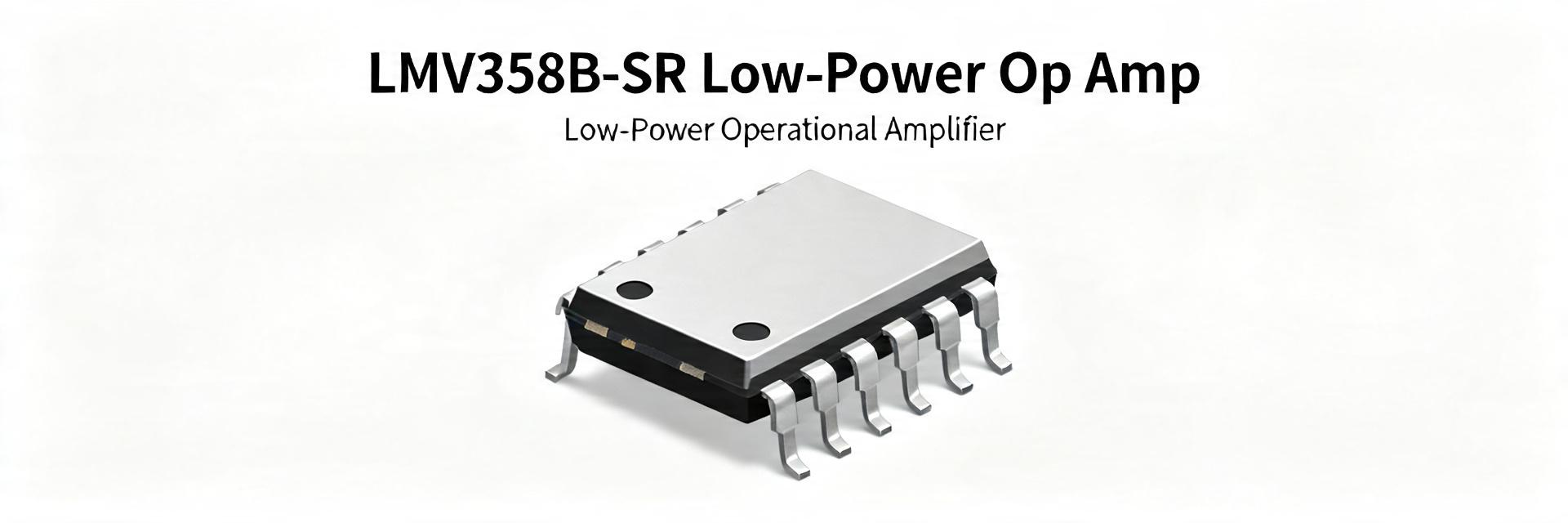
Common package options include small SOP and MSOP variants with standard dual‑op amp pinouts. Footprint and pad design should follow manufacturer land pattern recommendations. Watch thermal derating: in high ambient or tightly packed boards, limit continuous dissipation by derating supply range and consider forced convection or thermal vias for elevated power environments.
Expert Insight: Hardware Engineering Team
"During high-density PCB layouts for the LMV358B-SR, we noticed that placing the 0.1μF decoupling capacitor more than 5mm away from the VCC pin can introduce noticeable ringing during fast output transitions. Our Recommendation: Keep the return path to ground as short as possible. If using it in a high-impedance sensor buffer, apply a guard ring around the input pins to prevent leakage currents on the PCB from affecting DC accuracy."
3 — Performance benchmarks: measuring op amp performance
3.1 — Frequency response and gain‑stability tests
Run unity‑gain and closed‑loop tests (gain = 1, 2, 10) with small‑signal sine inputs (10–50 mVpp) and appropriate loads (10 kΩ typical, characterize at 2 kΩ). Expect bandwidth roll‑off near the 1 MHz GBW point and stable phase margin in unity and moderate closed‑loop gains. Measure with a network analyzer or FFT‑capable scope, and verify gain flatness and phase margin to ensure loop stability in chosen topology.
3.2 — Time‑domain tests: slew, settling, and output drive
Measure slew with large step inputs (rail‑to‑rail step amplitude) into representative loads (10 kΩ and 2 kΩ). Typical slew ~0.7 V/μs yields limited large‑signal edge rates—plan for slower settling in step responses. Check 0.1%–1% settling times for precision systems and verify tolerance when driving headphone or low‑impedance loads, where output swing and distortion degrade as drive demands increase.
4 — Design integration: practical circuits and layout tips
4.1 — Recommended circuit topologies
Use the LMV358B-SR as voltage follower buffers, single‑supply inverting/non‑inverting amplifiers, and first‑order RC low‑pass input filters. Keep feedback resistor values moderate (10 kΩ–200 kΩ recommended) to balance input bias offsets and noise. For low‑level sensor inputs, pair with low‑noise reference caps and avoid very large feedback resistances that amplify bias‑current‑induced errors.
Hand-drawn schematic, not a precise circuit diagram
4.2 — PCB layout, decoupling and ESD considerations
Place a 0.1 μF ceramic decoupling capacitor adjacent to VCC and VEE pins with minimal loop area; add a 1 μF bulk cap nearby for supply stability. Route analog grounds to a single star point where feasible, keep input traces short and shielded from digital switching. Add input series resistors and clamp diodes or dedicated ESD suppressors for sensor connectors to limit injection and protect inputs.
5 — Example application case studies
5.1 — Low‑power sensor amplifier (step‑by‑step)
Example: single‑supply 3.3 V system, non‑inverting gain = 10 for a 10 mVpp sensor. Choose Rf = 90 kΩ, Rin = 10 kΩ for moderate input noise and bias tolerance; expected quiescent draw ≈160 μA for the dual amp. Estimate SNR by combining sensor source noise and amplifier input noise; set simulation pass criteria for
5.2 — Low‑level audio buffer (practical tradeoffs)
As a headphone preamp buffer, the device can provide low‑level buffering but will be limited by GBW and slew for wideband audio with large swing. Expect adequate performance for low‑power earbuds at modest levels, but for high‑fidelity or high‑drive audio, a higher‑GBW, higher‑slew amplifier is preferable. Monitor THD and frequency response under intended load to validate acceptability.
6 — Selection, testing & deployment checklist
Decision Checklist: Picking LMV358B-SR
- Supply range: 2.5–5.5 V (Ideal for Li-ion).
- Power budget: ~80 μA typical per channel.
- Bandwidth: Needs
- Output: Rail-to-rail swing required.
- Load: Light loads (> 2 kΩ) preferred.
Production Test Checklist
- Verify DC offset & input bias.
- Check gain error at gain=1 and gain=10.
- Spot frequency response check.
- Quiescent current draw per channel.
- Temperature cycling margin checks.
Summary
- The LMV358B-SR is a compact RRIO dual op amp offering ~80 μA quiescent current per amplifier and ~1 MHz GBW, making it suitable for low‑voltage sensor front ends where power efficiency and rail‑to‑rail behavior outweigh high‑speed needs.
- Key technical specs such as supply range, slew rate (~0.7 V/μs) and output swing should be verified against specific RL and VCC test conditions in the datasheet before final selection for production designs.
- Practical integration emphasizes short analog traces, close decoupling, moderate feedback resistances and production tests for offset, gain and power to ensure reliable op amp performance in the field.