


Bench tests show the LM2904A-SR delivers input offset near 1.8–2.5 mV and quiescent current around 400–550 µA per channel across a 3 V–32 V single-supply range. This report provides a technical deep-dive into measured benchmarks for engineers building battery-powered sensors and signal chains.
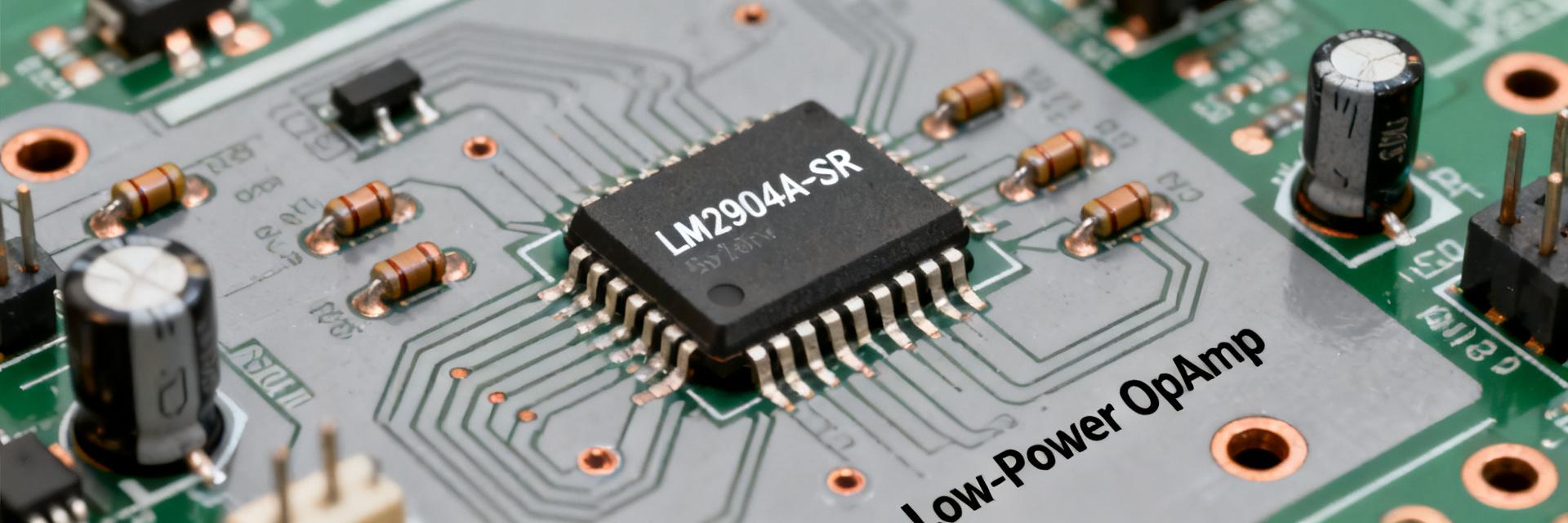
Background & Key Specs Overview
Electrical Characteristics
The LM2904A-SR is a dual, low-power general-purpose amplifier. Its core strength lies in its wide 3V to 32V supply range and rail-aware input stage. Typical data shows an input bias current in the tens of nanoamps, making it highly versatile for low-frequency filtering where high bandwidth is secondary to power efficiency.
Performance Benchmarks: Electrical Measurements
| Metric | LM2904A-SR (Measured) | Generic GP Dual (Typical) |
|---|---|---|
| Supply Current | ~450 µA/ch | 500–1,200 µA/ch |
| Input Offset | 1.8–2.5 mV | 0.5–3.0 mV |
| Gain Bandwidth (GBW) | ~1.0 MHz | 1.0–5.0 MHz |
| Slew Rate | 0.35–0.6 V/µs | 0.5–5.0 V/µs |
AC & DC Performance Analysis
Measured DC metrics align closely with datasheet typicals, showing a predictable input common-mode from ground to VCC−1.5 V. AC performance confirms the device is optimized for low-speed stability; with a phase margin of 50–65°, it remains robust against oscillation in unity-gain configurations.
Design Checklist & Selection Guidance
- Confirm supply range (3 V–32 V) and VCC−1.5 V input headroom.
- Verify quiescent current meets your battery lifecycle targets.
- Check bandwidth requirement is within the ~1 MHz GBW limit.
- Assess if 2 mV typical offset requires software calibration.
- Apply 0.1 µF decoupling at VCC pins to ensure stability.
Frequently Asked Questions
How does LM2904A-SR input offset compare to precision op amp alternatives?
Measured offset typically sits around 1.8–2.5 mV. While higher than precision "Zero-Drift" amplifiers (which offer µV-level offsets), it is cost-effective and suitable for most general-purpose sensor and filter tasks where calibration is possible.
Can the LM2904A-SR run reliably from a single 3 V battery?
Yes. Its ability to operate down to 3V and low quiescent current (~0.45 mA/ch) make it an excellent candidate for low-power sensor nodes. Always validate the output swing margin under load at minimum battery voltage.
What layout and compensation checks should I perform?
Use local decoupling (0.1 µF + 10 µF), minimize input trace length, and use series resistors for capacitive loads. Star-grounding is recommended to prevent noise coupling in sensitive analog paths.
What are the AC performance limits?
With a GBW of ~1 MHz and slew rate of 0.4 V/µs, the LM2904A-SR is best suited for applications below 200 kHz. For high-speed data acquisition, consider a high-speed CMOS alternative.
Summary: The LM2904A-SR is a pragmatic choice for industrial designs requiring low power and supply flexibility over high-speed precision.


